


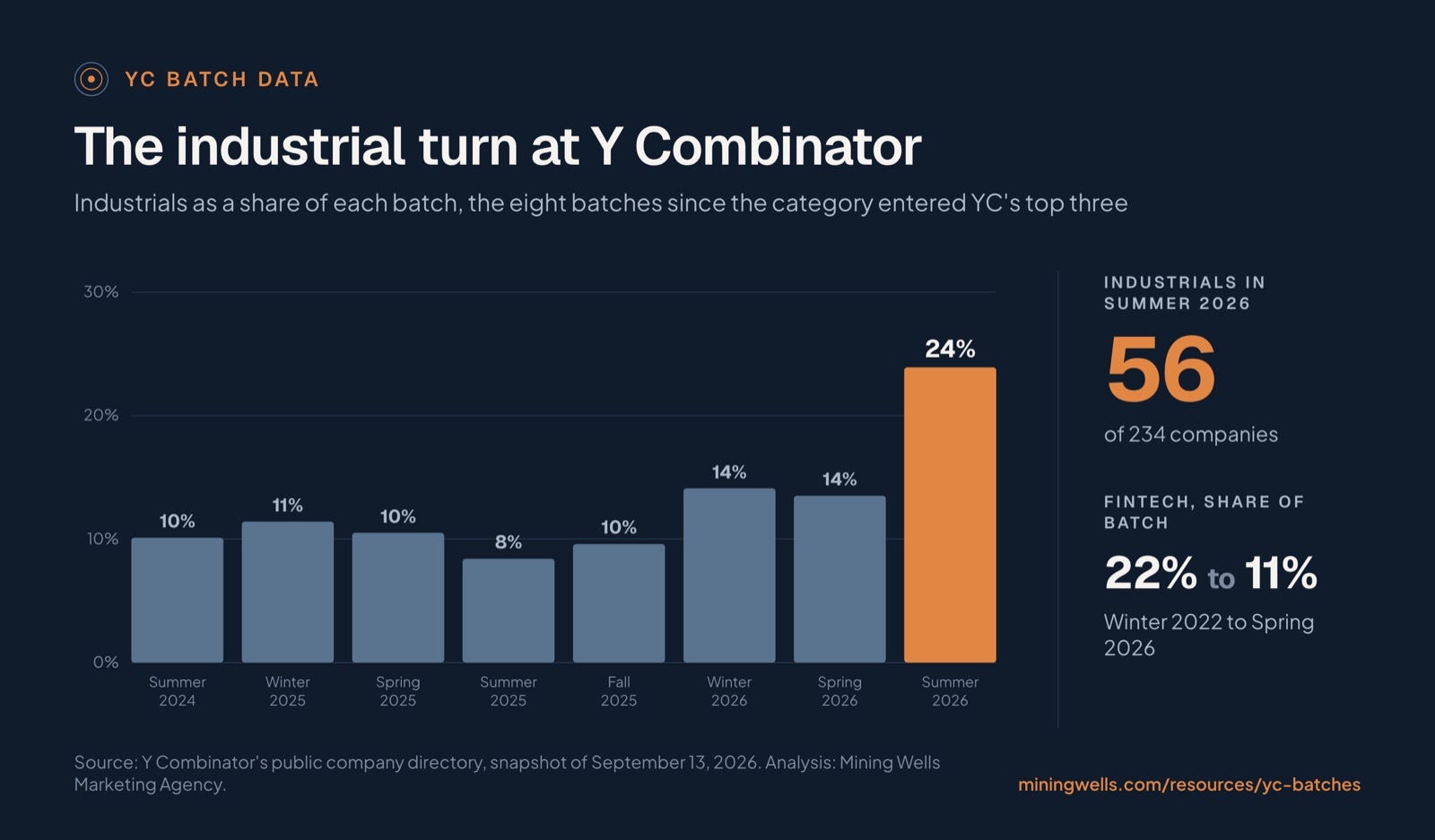
Fifty six of the 234 companies in Y Combinator’s Summer 2026 batch are industrial companies. That makes Industrials the second largest category in the batch, behind only B2B software, and nearly a quarter of everything YC funded this summer.
Two years earlier, in Summer 2024, it was 25 of 248. About one in ten.
We built this from YC’s own public listing, batch by batch, and it is one of the two sharpest shifts in what YC funds anywhere in the last five years of data. The other one is below.
Two years of the same number, then a jump
What makes the chart interesting is its shape. It is not a steady climb.
From Summer 2024 through Fall 2025, Industrials held between 8 and 11 percent of every batch, five batches in a row. Winter 2026 moved it to 14 percent. Spring 2026 held there. Then Summer 2026 landed at 24 percent, and the first 51 companies listed for Fall 2026 are running at the same rate, 12 of them industrial.
That is what a change in direction looks like, as opposed to a trend line. Something moved between the spring and the summer.
Fintech went the other way
In Winter 2022, 89 of YC’s 398 companies were fintech. That was 22 percent of the batch, second only to B2B.
By Summer 2023 it was 7 percent. In Spring 2026 it was 11 percent, 21 of 193, and in Summer 2026 fintech no longer made the top three at all. Healthcare took the third spot.
YC did not stop funding hard problems. It moved to a different kind of hard problem.
YC is telling founders what it wants
You do not have to guess at why. Y Combinator publishes a list of the companies it wants to fund, its Requests for Startups, and the current list reads like a description of this chart.
It includes “The Future of American Defense,” which asks for things like low-cost interceptors, next-generation sensors, drones and advanced manufacturing. It includes “New Operating Systems for the Physical World,” about robots actually deployed in the field for construction, maintenance and fleet work. There is “Compute at Sea,” about offshore data centers, and “Data for the Real World,” which includes robots that collect data in places that are hard to reach.
When the most closely watched accelerator in startups starts asking for companies that build physical things, founders listen. The Summer 2026 batch is what listening looks like.
Why this matters past the batch
Here is the part that is easy to miss, and it is the part I think about most, because it is our job.
An industrial company does not get sold the way a software company does. The buyer is a plant manager, a fleet operator, a procurement team or a government program office. The sales cycle runs months or years instead of days. Nobody signs up with a credit card. A deal needs a committee to agree, and each person on it needs a different reason to say yes.
A lot of what the startup world knows about growth was learned selling software to other software companies: a free trial, a fast demo, a self-serve checkout. Very little of it survives contact with a buyer who has to justify a purchase to an engineer, a finance lead and a safety officer at the same time.
So if nearly a quarter of a YC batch is now selling to industrial buyers, a lot of founders are about to learn a different playbook: proof over polish, case studies over clever copy, and a message that works for every person in the room, not just the one who took the first call.
Go deeper
Y Combinator publishes what it wants funded next, and we read all 13 ideas on its current Requests for Startups so you do not have to, with who would actually buy each one.
If you are wondering how hard it is to get into a batch at all, here is what YC has published about acceptance, with batch sizes through 2026 and the standard deal. And if you are an industrial founder starting to raise, we keep a free directory of venture capital firms, organized by region and stage.
Nothing to sign up for. It is there to use.
Jessica Wells is co-founder of Mining Wells Marketing Agency. She is a four-time founder with more than a decade in marketing and growth, and a former consultant at Booz Allen Hamilton.
Source: Y Combinator’s public company directory, snapshot of September 13, 2026, using the industry labels YC assigns. YC’s Requests for Startups quoted from ycombinator.com/rfs.
If this was useful, subscribe. Every issue is one finding from data we compiled ourselves, in one short read.